Guides
How to rank profitable ice cream shop products
A ranked order for profitable ice cream shop products, from take-home pints and soft serve to sundaes and affogato, plus the variables and formula behind it.
What to take away
- Rank your own menu of profitable ice cream shop products by contribution per serving: price minus mix cost at your overrun, minus vessel, minus labor seconds.
- Take-home pints of a proven counter flavor usually top the list. Labor is low and the sale happens in the quiet hour.
- Soft serve and gelato are not the same business. Soft serve runs high overrun and few labor seconds; dense gelato gives away margin at ice cream prices.
- Composed desserts like affogato and sundaes rank high off-peak and low on a hot Saturday, when assembly seconds cost you the next sale.
- The flavor nobody orders is your worst product whatever its paper margin, because the batch is made and never served.
The seven, ranked
Ranking assumes one shop, one counter, one freezer. Your dairy invoice and your overrun decide the order, so treat this as the starting order and re-run it with your numbers.
- Take-home pints of a proven counter flavor.Packed in the quiet hour, so labor seconds are near zero, and the container fixes the serving. A winter Friday sale that scooping cannot reach.
- Soft serve.High overrun means more servings per liter of mix, and the machine does the portioning. Watch mix cost and machine service, not labor.
- Cake cones and waffle cones.The vessel costs more than a paper cup, but a smaller scoop reads generous and the customer eats the evidence.
- Ice cream cakes and logs.Made ahead, priced high, sold in January. They tie up freezer space and need ordering lead time.
- Gelato by the cup.Dense, so fewer servings per liter than soft serve, and it must be priced for that density or it gives margin away.
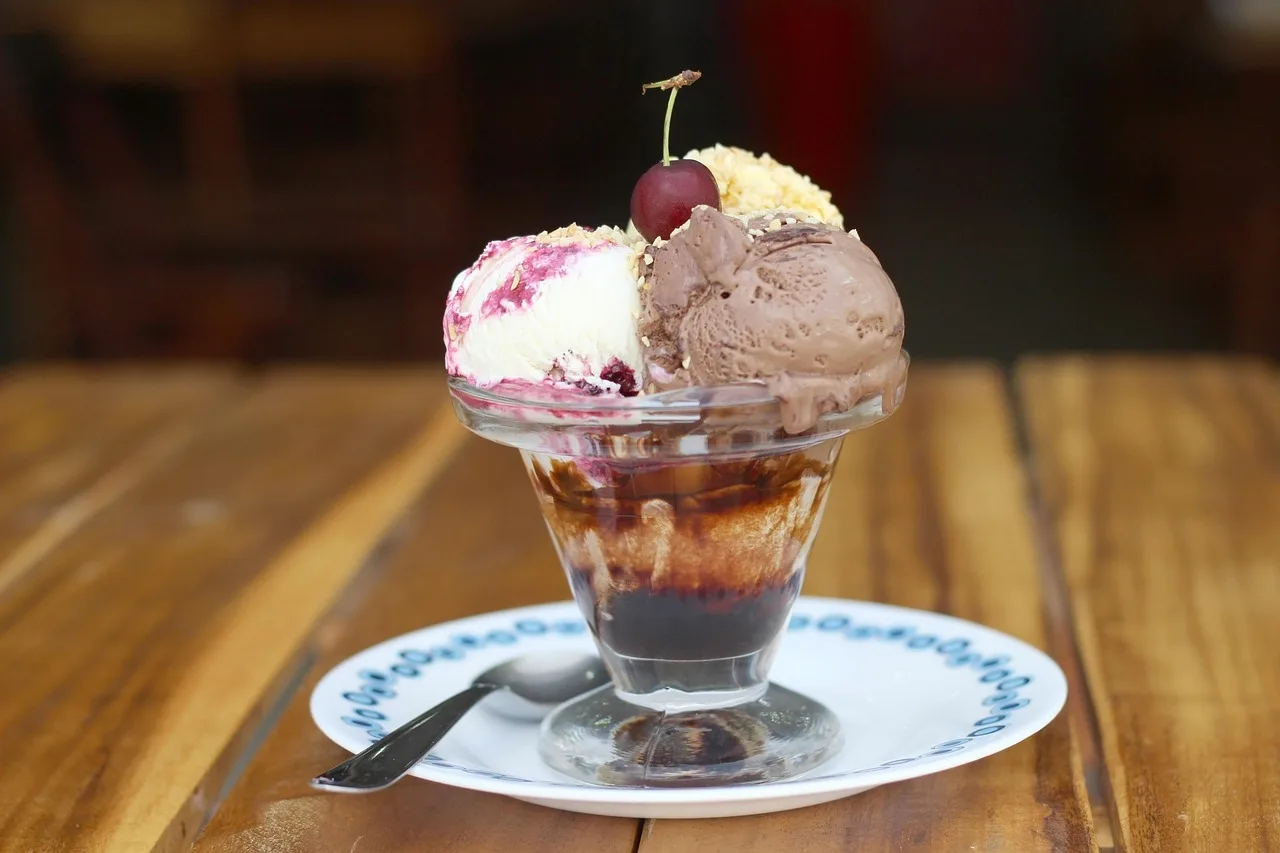
- Sundaes.Toppings raise the price and the plate cost together. Fine off-peak, expensive at 3pm on a Saturday.
- Affogato and floats.Highest assembly seconds on the menu. The espresso machine and the soda gun make them fast only after the staff know the sequence cold.
The variables behind the ranking
For any product, define these and the order sorts itself:
- M, mix cost per liter as it enters the batch freezer, from the current invoice, inclusions included.
- O, overrun for that flavor, measured by weighing a fixed volume of finished product against the same volume of mix.
- V, the volume of one serving as actually scooped, weighed, not as written on the menu.
- C, vessel and everything handed over with itcup or cone, spoon, napkin, lid, label.
- L, labor seconds from "next please" to the till closing, at your own wage rate.
- P, the price the customer pays.
Contribution per serving is P minus the ingredient cost of V liters at overrun O, minus C, minus L. Ingredient cost falls as O rises, because more of the serving is air.
That is the commercial difference between soft serve and dense gelato, and it is why the two are priced differently.
A shop selling gelato at ice cream prices with gelato overrun is giving away the difference.
Where each product earns its place
Pints. V is fixed by the container, L is near zero, C is the pint, lid and label. A flavor that already sells at the counter usually contributes more per liter of dairy as a pint than as scoops. Package design has its own constraints.
Soft serve. High O, low L, and a machine lease or service contract to carry. The mix cost per liter is the variable to watch, because the machine hides portion drift until you weigh a cone.
Cones. C is higher than a cup, but a smaller V looks generous and the customer eats the vessel. Weigh twenty real cones on a busy evening before deciding which the staff offer first.
Cakes and logs. L spreads across quiet hours and P is usually high. They need freezer space and an order book, and they sell against the calendar, not the weather.
Gelato. Dense means fewer servings per liter. Price it for the density or the margin goes into the cup. Batch freezer versus continuous system changes the labor line, not the arithmetic.
Sundaes. Toppings lift both P and plate cost. Off-peak, when staff are idle anyway, L costs nothing and sundaes are excellent.
Affogato. The espresso pull and the assembly are the whole cost. Train the sequence and it drops; skip the training and it eats a Saturday.
The removal rule
Write it before you need it. Something like: a flavor whose pan returns to the freezer more than half full on more than half of nights over two weeks is cut, made smaller, or moved to a rotating slot. The rule is yours. The point is that it exists in writing so the decision is not a mood.
The flavor nobody orders fails not on contribution per serving but on waste. Most of the batch is never served. Track waste separately, per flavor, by weight.
What you may say about the winners
Menu boards and signs are advertising, and the Federal Trade Commission: Advertising FAQs: A Guide for Small Business sets out the general rule that claims must be truthful and substantiated.
"Made here this morning" must be true this morning. That belongs in counter training, not on a poster in the back.
The records that make it possible
The formula needs the dairy invoice, a measured overrun, a weighed serving, and sales by product from the till.
The Internal Revenue Service: What kind of records should I keep? page describes the purchase and sales records a small business should hold in any case.
Set the till up by product line and flavor and the ranking comes free with the tax records.
If a product is packaged for sale off the premises, labeling and handling questions go to the state agency that governs retail food. The U.S. Food and Drug Administration: State Retail and Food Service Codes and Regulations directory names it, and the licensing questions for packaged product are worth reading before printing a pint label.
Worked example, in variables only
Two flavors, A and B, same P, C and L. A is a plain vanilla: low M, high O. B is a pistachio: expensive inclusion, so high M, and a dense texture, so low O.
Per serving, A's ingredient cost is small twice over, cheap mix and much of the serving is air. B's is large twice over.
Unless B's P is higher, A contributes more.
Now add waste. If A sells out nightly and a third of every B batch is discarded, B falls further. Whether B stays depends on whether pistachio customers buy other things, which is a question for your till data.
The full menu framework puts these lines into a structure; the approach to winning repeat customers covers the other half of the pistachio question.
Common questions
Is it really true that plain flavors are the most profitable?
Often, on the per-serving arithmetic, because the mix is cheap and the overrun is forgiving. Whether that makes them the right thing to push is a different question. A shop that only sells vanilla has a weak story.
How do I measure overrun without a lab?
Weigh a container of mix, then weigh the same container filled level with finished product from the machine. The weight difference for the same volume gives you the air. Do it per flavor.
Where do I check the rules for selling pints off-site?
Your state agency that governs retail food sets labeling and handling requirements, and they vary by state. The FDA state codes directory names the authority for each state. Confirm with them before printing a label.
What about gelato versus soft serve on the same menu?
Run both through the formula with your real V and L. Soft serve usually wins on servings per liter; gelato wins on price per serving if the customer accepts the density. The menu can carry both if the freezer space allows.