Guides
How to Calculate Gelato Overrun and Why It Changes Your Food Cost
Calculate gelato overrun to find your real food cost per scoop. A 25% batch vs a 45% batch changes cost per serving by cents you can price against.
What to take away
- Overrun is the air you whip into the mix, expressed as a percentage of mix volume. A 1 gallon batch of mix at 30% overrun yields 1.3 gallons of finished gelato.
- Food cost per scoop moves inverse to overrun. Doubling air cuts mix cost per fluid ounce of finished product roughly in half.
- Most US gelato sits between 20% and 35% overrun. American ice cream under 21 CFR 135.110 can run 50% to 100%.
- Your target butterfat sets a floor on overrun. Push air too far and the finished product fails the composition math in the standard of identity.
- Track cost per finished gallon, not cost per mix gallon. That single line is where margin hides.
The overrun formula in shop terms
Overrun = (finished volume minus mix volume) divided by mix volume, times 100. If 1 gallon of mix becomes 1.3 gallons in the batch freezer, overrun is 30%.
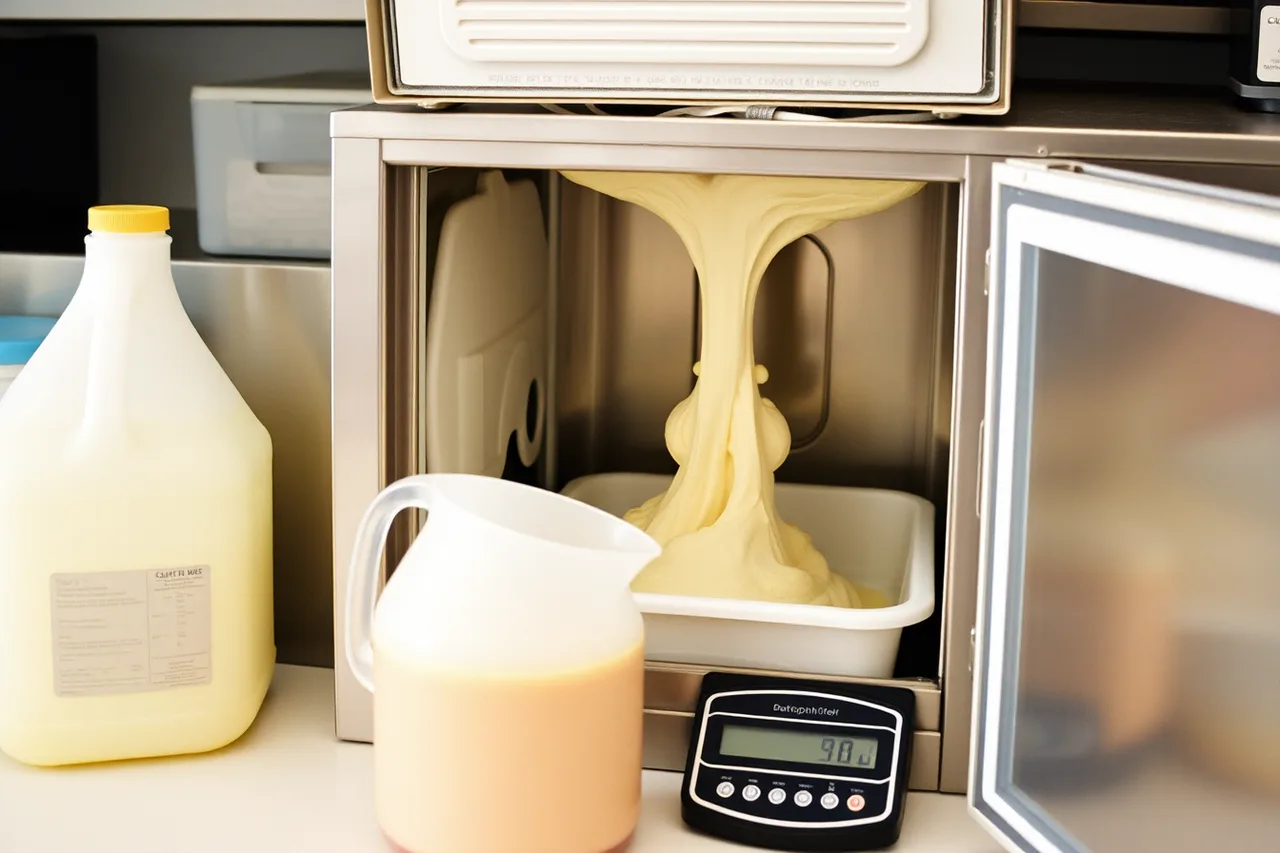
You can also weigh it. Overrun = (weight of mix minus weight of same volume of finished gelato) divided by weight of finished gelato, times 100. A scale is faster than a bucket when you run small test batches.
Federal standards for frozen desserts live at 21 CFR Part 135. That is the rule that ties your label claims to composition. Ingredients that hold the air structure, such as stabilizers, are listed on the FDA food additive status list.
Line by line cost per batch
Figures below are illustrative for a 10 gallon mix batch at $2.40 per pound of mix. Your dairy contract sets the real number, so read USDA dairy grading and gelato ingredient sourcing before you lock a supplier.
| Line | Low | High |
|---|---|---|
| Mix, 10 gal at 20% overrun | $92 | $118 |
| Mix, 10 gal at 35% overrun | $92 | $118 |
| Finished gallons from that mix | 12 | 13.5 |
| Mix cost per finished gallon | $6.81 | $9.83 |
| Scoops per finished gallon (4 oz) | 32 | 32 |
| Mix cost per scoop | $0.21 | $0.31 |
| Cup, spoon, napkin | $0.09 | $0.16 |
| Total food cost per scoop | $0.30 | $0.47 |
One labelled column matters here: the low-to-high range. The mix cost line does not change with overrun. Everything downstream does.
What scale changes
Batch size changes the number more than most owners expect. A 10 gallon batch at 30% overrun yields 13 gallons, or 416 four-ounce scoops. A 2.5 gallon pilot batch at the same overrun yields 3.25 gallons, or 104 scoops.
The pilot batch costs more per scoop because you lose mix in the machine and in the transfer. Expect 4% to 8% loss on a small batch and 1% to 3% on a full one. That gap is the reason a 5 gallon test run at $0.55 per scoop can become $0.34 per scoop at scale.
If you sell from a cart, the loss rate climbs again. Read US cottage food laws for selling gelato from a cart before you price a route.
What is easy to forget
- Weigh the finished pan, not the mix you poured in.
- Record overrun on the batch sheet the same day.
- Recheck overrun after any machine blade service.
- Recalculate cost per scoop after every dairy price change.
Overrun drift of 5 points on a 4 ounce scoop is worth roughly $0.03 to $0.05 per serving. On 400 servings a day, that is $12 to $20 daily.
Where the margin actually goes
Air is free and mix is not, so higher overrun lowers food cost per scoop. That is the whole trade. Push it too far and the gelato eats thin, melts fast, and customers notice texture before they notice price.
Stabilizer choice changes how much air the mix holds. Locust bean gum and guar gum behave differently in a low-fat base, and both are permitted under their own rules. See the carrageenan and guar gum entries for the limits.
Butterfat is the other lever. A 10% butterfat gelato tolerates more air than a 16% base before it tastes watery. That is why a shop selling both gelato and ice cream cannot use one overrun setting for both.
Hold temperature steady and the math holds. The FDA Food Code sets the holding requirements that keep your yield from collapsing in the case.
Example: two shops, one mix price
Shop A runs 22% overrun and sells 300 scoops a day at $4.50. Food cost per scoop is $0.41. Daily food cost is $123.
Shop B runs 34% overrun on the same mix and sells 300 scoops at $4.50. Food cost per scoop is $0.33. Daily food cost is $99.
The $24 daily gap is $8,760 a year on the same mix invoice. Shop B has to watch texture and melt time, but the cost difference is real.
Common questions
Does overrun change my butterfat percentage?
Yes. Air dilutes everything, including fat. If your mix is 12% butterfat and you double the volume with air, the finished product is roughly 6% butterfat. That is why high-overrun products need a richer mix to hit the same taste.
How often should I measure overrun?
Weekly at minimum, and after every batch freezer service or blade change. A 5 point drift is easy to miss on a spoon and obvious on a scale.
Can I price by weight instead of scoop?
Some shops do. It removes the overrun variable from the customer side but adds scale cost and slows the line. Most US parlors still price by scoop size.
Where does the rest of my margin go?
Labor, rent, and waste. Once food cost per scoop is accurate, the next lever is staffing and scheduling, which getting ice cream shop staff up to speed covers in detail.