Guides
Suppliers and stock for an ice cream shop
Ice cream shop inventory and sourcing guide: the three stocks a scoop shop holds, the display case as inventory that melts, and the sourcing routes compared.
What to take away
- Suppliers and stock for an ice cream shop split into three systems: dairy and mix, inclusions and flavorings, and packaging and consumables.
- An ice cream shop holds three kinds of stock, and they behave differently. Dairy and mix spoil. Inclusions and flavorings are expensive and slow. Packaging is cheap and bulky. Manage them as three systems.
- The display case is inventory. Every pan in it is losing quality from the moment it is filled, and a case run without a discard rule is a case that composts money.
- Sourcing has three routesmake mix from raw dairy, buy pasteurized mix and freeze it, or buy finished product. They differ in license, equipment, margin and risk, and the choice is the first inventory decision.
- Dairy is a regulated supply chain. Keep delivery notes, invoices, and temperature logs.
Stock rules at a glance
- Dairy and mixshort orders, frequent deliveries, a cold chain from the truck to the freezer, and days of cover sized to the delivery gap.
- Inclusions and flavoringsorder by flavor plan, store by allergen, count by value, and keep slow movers on one shelf.
- Packaging and consumablesorder by case, hold at the peak-week level, and store in a dry area with the most-used sizes at hand height.
- Layoutraw dairy and mix below ready-to-eat items. Allergens on a separate shelf with separate scoops. Label every opened container with the date.
- Rotationfirst in, first out on every shelf.
Why this is a framework and not a par list
A par level is a number for one shop, on one street, in one week. A beach kiosk in August differs from a neighborhood corner in November. What holds for everyone is how the three stocks behave, what the case does to product, how sourcing routes differ, and how to derive your own numbers.
Worked par example. Par equals average daily usage times days between deliveries, plus safety stock. A shop uses 40 pounds of base on an average day. If the dairy delivers twice a week, the gap is 3.5 days. Par is 40 times 3.5, or 140 pounds, plus one safety day of 40 pounds, or 180 pounds.
For a once-a-week delivery, the same usage gives 40 times 7, or 280 pounds, plus 40 pounds of safety, or 320 pounds. More days of cover means more spoilage risk.
Define the three stocks: dairy, inclusions, packaging
| Stock | What it is | How it fails |
|---|---|---|
| Dairy and mix | Heavy cream, whole milk, sugar, pasteurized ice cream base, or finished tubs | Spoils; runs out on the hot weekend; price moves with the dairy market |
| Inclusions and flavorings | Chocolate, fruit purees, nut pastes, variegates, vanilla, stabilizers | Expensive; slow to turn; some are allergens that need separation |
| Packaging and consumables | Cups, lids, compostable cups, cones, labels, bags | Runs out on the busiest day; takes space; cheap per unit |
The mistake most first-year shops make is to manage all three the same way, usually the way they manage packaging: order a lot, check occasionally. Applied to dairy, that produces spoilage. Applied to inclusions, it ties up cash in a jar of pistachio paste from PreGel or Fabbri that lasts a year.
Three stocks and how they fail
Dairy and mix
- What it is
- Milk, cream, base, tubs
- How it fails
- Spoils; runs out hot weekend
- How managed
- Short orders, frequent deliveries
Inclusions and flavorings
- What it is
- Pastes, purees, chocolate, stabilizers
- How it fails
- Expensive; slow to turn
- How managed
- By flavor plan, by allergen
Packaging and consumables
- What it is
- Cups, cones, spoons, pints, lids
- How it fails
- Runs out on busiest day
- How managed
- By case, peak-week level
The display case as inventory
The case is where inventory becomes revenue, most often wasted, and a pan holds a fixed amount. From the moment it goes in, the product sits at serving temperature, gets scooped, hits air, and loses its hardened texture.
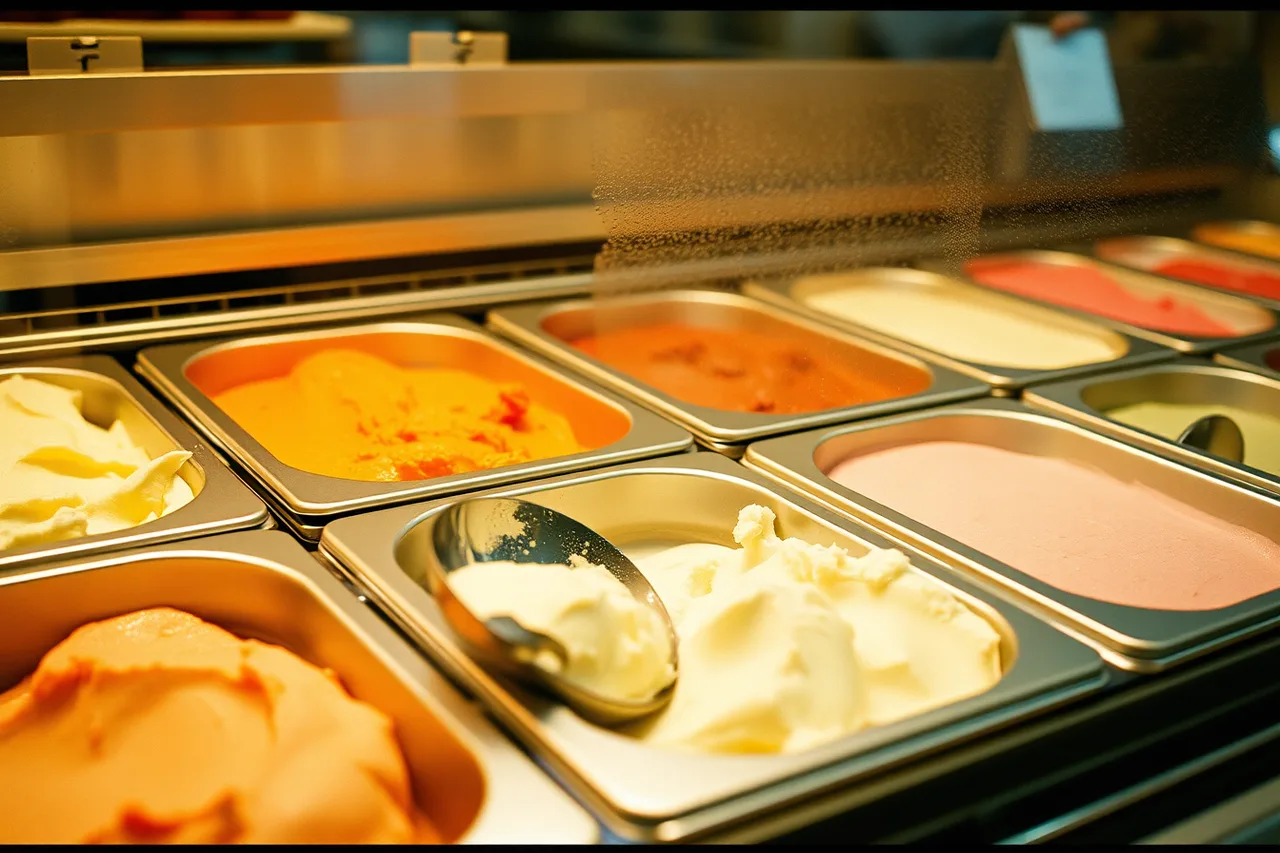
Each shop sets a hold time, after which the pan is discarded or returned to hardening if the process allows. That time depends on the product and your own records.
Given a hold time, every pan is a bet that its flavor will sell through before the time is up.
Flavors that lose that bet are the waste line. Measure it: weigh what comes out of the case at close, per flavor, and keep the record. Three weeks of that record tells you more about your menu than any customer survey.
Assess what you already have
Before choosing a sourcing route, write down:
- Whether you have, or will have, a pasteurizer and the license that goes with it.
- How many pans the case has, which sets the number of flavors and therefore the number of inclusion lines.
- How much freezer capacity exists for hardening and for holding packaged product.
- How far the nearest dairy supplier, such as Prairie Farms, Hiland Dairy, or Shamrock Farms, is and how often they will deliver.
- Whether anyone on the team has handled raw dairy commercially before.
The sourcing routes compared
Equipment and license
- Make mix from raw dairy
- Pasteurizer, batch freezer, blast chiller; often a dairy or frozen dessert plant license
- Buy pasteurized mix and freeze on site
- Batch freezer and hardening; usually retail food
- Buy finished product and dip
- Cases and freezers only
Margin
- Make mix from raw dairy
- Highest, once running
- Buy pasteurized mix and freeze on site
- Good
- Buy finished product and dip
- Lowest
Control over the product
- Make mix from raw dairy
- Total
- Buy pasteurized mix and freeze on site
- High: flavor, overrun, inclusions are yours
- Buy finished product and dip
- None beyond choice of supplier
Main risk
- Make mix from raw dairy
- Process records, dairy handling, the license itself
- Buy pasteurized mix and freeze on site
- Dependence on the mix supplier's delivery on the hot weekend
- Buy finished product and dip
- Product is the same as any other shop's; thin margin; no winter story
Suits
- Make mix from raw dairy
- High-volume shop with a production kitchen and capital
- Buy pasteurized mix and freeze on site
- Most small and growing shops with a batch freezer
- Buy finished product and dip
- Kiosks and very small shops with no production space
Compare routes on license, equipment cost, margin, control, and delivery risk.
Which license each route needs is the state's to say. The U.S. Food and Drug Administration: State Retail and Food Service Codes and Regulations directory names the agency that governs retail food in each state. Ask that agency whether an on-site pasteurizer changes your class; the questions to put to the licensing bodies cover the rest.
Set goals that can be measured
- Waste by weight per flavor per weekfrom the close-of-day record,.
- Stockouts on peak dayscounted,: every time a flavor or a consumable ran out on a Saturday.
- Days of dairy on hand, so that a delivery failure is survivable but a spoilage loss is small.
- Inclusion value on the shelfvalue, so that the cash tied up in slow flavors is visible.
- Cost per servingrecalculated each time the dairy invoice changes.
Numbers three and four pull in opposite directions, and that tension is the whole job.
Five measurable inventory goals
- Waste by weight per flavor per week
- Stockouts on peak days, counted
- Days of dairy on hand
- Inclusion value on the shelf
- Cost per serving after dairy invoice changes
Understand the constraints
Approved sources. The model U.S. Food and Drug Administration: Food Code 2022 uses the term "approved source" for where food may come from. For dairy, keep the documentation that proves the source with each delivery.
For a supplier such as Prairie Farms or Shamrock Farms, that paperwork usually starts with the delivery invoice and a temperature log.
Cold chain. Mix and dairy arrive on a truck, cross a pavement, and enter a freezer or a cooler. The minutes between the truck and the door are where product is lost in August. Delivery timing and a clear route from the door to cold storage are inventory questions, and they are decided by the layout of the premises you chose.
Whether the truck is from Sysco, US Foods, or a local dairy, those minutes count.
Allergens. Nut pastes from PreGel or Fabbri, wheat inclusions from Joy Cone, and dairy itself are allergens. Storage that keeps them separate, scoops that do not cross, and a case plan that puts the nut flavors where they cannot drip into the next pan are inventory controls as much as safety controls.
Records. Every delivery, every discard and every count is a record. The Internal Revenue Service: What kind of records should I keep? page describes the purchase records a small business needs for tax in any case; the same delivery notes and invoices serve the inspector and the cost-per-serving calculation.
The system that holds the records. If stock is counted on a tablet and ordered through a supplier portal, that system holds your supplier logins, your prices and your card details. The National Institute of Standards and Technology: NIST Small Business Quick-Start Guides are written for exactly this size of business and cover the basics of keeping such systems from being the weak point.
Portals from Sysco, US Foods, or WebstaurantStore are examples.
Choose an approach and plan the phases
- Pick the sourcing route from the table, after asking the state agency what license it carries. For raw dairy, that may mean Prairie Farms or Hiland Dairy; for pasteurized mix, Crystal Creamery or Shamrock Farms.
- Set the flavor plan from the number of pans, and the inclusion list from the flavor plan. Every inclusion should map to a flavor that is in the case. A Guittard chocolate flavor, a PreGel pistachio flavor, and a Perfect Purée raspberry flavor are examples.
- Agree delivery days and times with the dairy or mix supplier, and a fallback for the weekend they cannot come.
- Set an opening par for each stock from the peak-week estimate, and revise it after the first three weeks of counts.
- Start the close-of-day waste record on day one.
- Review pars at the turn of each season, because the summer par is wrong in October.
Budget beyond the ingredient invoice
Inventory costs more than the invoice shows. Freezer space, tied-up cash, product discarded from the case, delivery charges on small top-up orders, and time spent counting all add up.
Typical ranges as of 2026, in most U.S. markets:
- Small top-up delivery charge$25 to $75 per drop.
- Used three-door display freezer$2,000 to $6,000. New: $8,000 to $20,000.
- 3-gallon tub of pasteurized ice cream base from a regional dairy: $45 to $75, depending on butterfat and distance.
- 25-pound box of Guittard or Callebaut chocolate chips$90 to $160.
- Case of 1,000 12-ounce paper cups from Dart Container$60 to $120.
Cheap supplier versus frequent delivery
Cheaper, once a fortnight
- Unit price
- Lower
- Delivery charges
- Fewer top-up orders
- Spoilage risk
- Higher
- Stockout risk
- Higher
Dearer, twice a week
- Unit price
- Higher
- Delivery charges
- More small orders
- Spoilage risk
- Lower
- Stockout risk
- Lower
A supplier who is cheaper per unit and delivers once every two weeks can cost more than one who is dearer and comes twice a week. Spoilage and stockouts close the gap.
What to hand to a food safety consultant
Sourcing is yours. Process records for a pasteurizer are worth a food safety consultant's time. The wider startup framework puts the sourcing decision where it belongs in the sequence: after the product is proven, before the equipment is ordered.
Run the daily inventory routine
Inventory is a daily routine: a count, a delivery check, a waste weigh, an order. It fails when it belongs to nobody. Name the person for each shift, keep the records where the inspector and the accountant can both find them, and read the waste record every week as a note from the case about your menu.
Common questions
How much stock should I hold?
Use the par formula above. Enough dairy to survive a missed delivery on a hot weekend, and no more, because dairy spoils. Enough packaging for the peak week. Inclusions by flavor plan only.
If your dairy is Prairie Farms and it delivers twice a week, three days of cream is often enough. If it is a once-a-week drop from a broadline distributor like Sysco, hold more.
Can I buy finished product and still call myself a gelato shop?
You can sell it. Whether you can describe it as made here is an advertising question, and the honest answer is no. The margin and the winter story both suffer, which is why the table above is candid about that route.
Buying tubs from Blue Bell, Turkey Hill, or Perry's and reselling them is the route the table calls thin.
What records does the inspector want for dairy?
Keep every delivery note and invoice with the date and the temperature on receipt.