
Guides
How to Test Ice Cream Shop Trends in Your Store
Ice cream shop trends are useful only when your own sales support them. Use a six-step test before changing your menu, staffing, or operations.
What to take away
- Most writing about ice cream shop trends in this trade is a list of flavors somebody saw. A flavor is not a trend; it is inventory with a fashionable name and a short shelf life.
- Potential demand shifts to examine are slower and dullerwhat people can eat, when they go out, how they pay, and what they expect to take home.
- No statistics appear on this page. Any figure worth acting on is one you measured in your own shop, and the test for every claim below is the same: does your till agree?
- Respond to a shift by running an experiment with a defined end date, not by rebuilding the menu.
What counts as a trend
Three tests. A shift is worth acting on if it has lasted more than two seasons, if it changes behavior rather than only conversation, and if you can see it in your own sales rather than only in an article.
Three tests for a trend
Has it lasted more than two seasons?
passes the durability test
one-summer flavor, do not act
A flavor that appears everywhere for one summer fails the first test. A widely discussed dietary preference that nobody actually orders at your counter fails the third. Both are worth knowing about and neither justifies capital.
Potential demand shifts to test
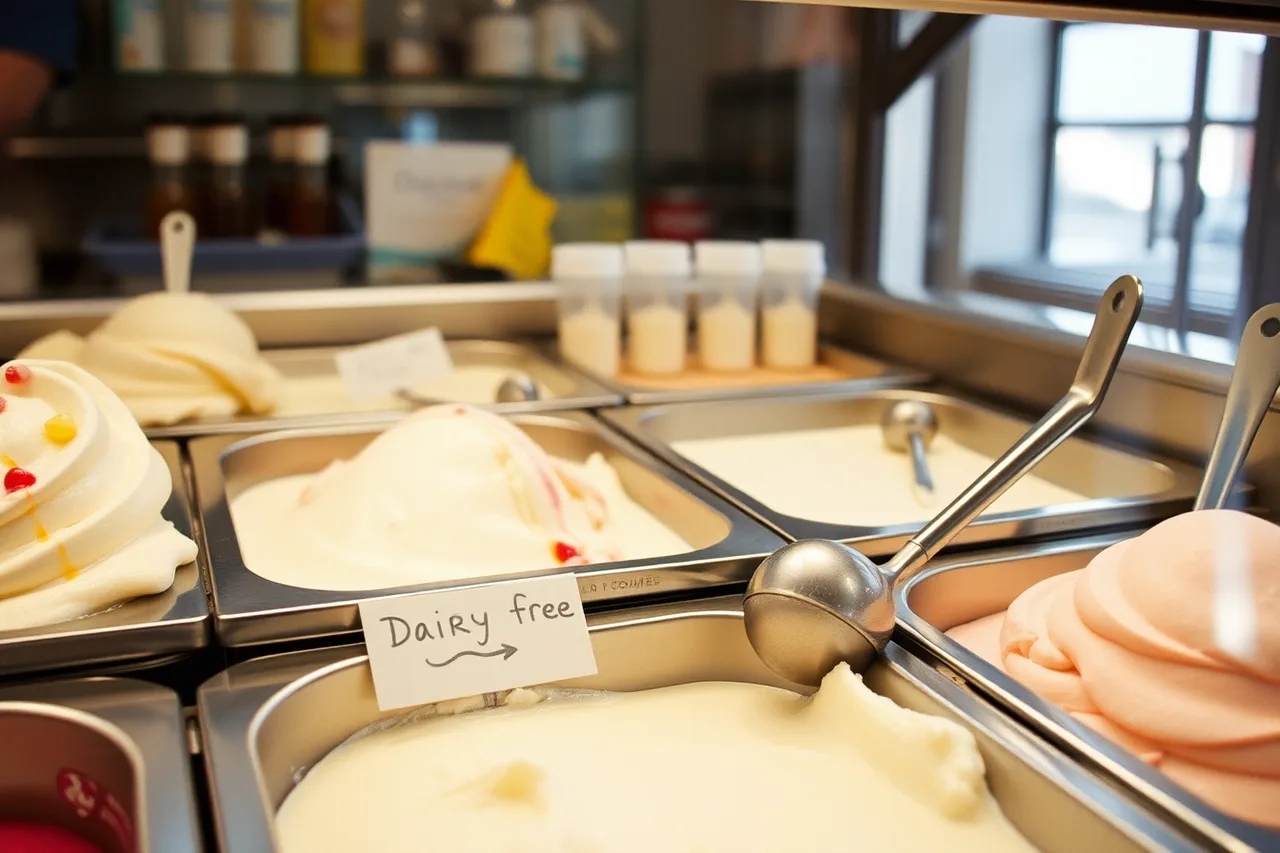
Dietary range is now expected, not requested. Dairy-free, and increasingly nut-aware and gluten-aware, has moved from a special request to something a group assumes will exist before choosing where to go. The commercial point is not the individual customer; it is that one person in a group of five decides where the group does not go. That is why an empty dairy-free pan is expensive out of proportion to its own sales.
Allergen information is expected to be immediate and accurate. Customers ask, and they expect a clear answer including the honest limits of shared equipment. What must be declared and how varies by jurisdiction and by whether the product is packaged; ask the agency named for your state in the U.S. Food and Drug Administration: State Retail and Food Service Codes and Regulations directory rather than assuming, and settle it alongside the licensing questions this trade raises.
Take-home is a real channel, not an afterthought. People buy dessert to eat at home in a way they did not a decade ago, and that is the shift with the largest effect on a seasonal shop's annual arithmetic, because it earns in the cold months.
Provenance is a purchase reason for some customers. Made here, named dairy, named fruit. It is a smaller group than the enthusiasm suggests, and it is a group that spends more and comes back. It is also a set of claims you have to be able to support.
Payment expectations have shifted. Card and phone for small amounts, and impatience with anything slow at the counter. In a business where the queue is the constraint on a hot Saturday, transaction speed is a demand factor and not only a convenience.
Late evening trade has grown where streets support it. Where towns have evening life, the ice cream hour has moved later. Where they do not, nothing has changed. This one is entirely local.
Weather is becoming less predictable, not simply warmer. The planning consequence is not a longer season; it is a less reliable one. A shop that can open flexibly when the weather turns has an advantage over one running a fixed roster.
The noise
Flavor fashions, single-ingredient crazes, presentation styles built for photographs, and equipment sold on the promise of a new category. None of it is worthless and none of it is a reason to change the business. Run these as specials with an end date and let the till decide.
Be particularly careful with anything that adds assembly time to a peak-hour sale. A product that photographs well and takes four minutes to build costs you the three customers behind it in the queue, and that loss never appears on the line's own sales figure.
Testing a trend on your own street
- State it as a sentence that could be false. "Dairy-free is holding back groups from coming in" is testable; "plant-based is growing" is not.
- Decide what you would see if it were truea specific line's sales, a specific question asked at the counter, a specific time of day filling up.
- Run it for a defined period, long enough to include several weekends and both warm and cool days.
- Record it in the till as its own line so the result exists later.
- Read the result against the same period last year rather than against last month.
- Decide, and write the decision down with the date. Trends that are never formally rejected accumulate as menu clutter.
What a shift costs you before it earns
Every one of the durable shifts above has an operational cost that arrives before any revenue does.
What each shift costs first
Shift
- Dietary range
- Pan slot, separate scoops
- Allergen accuracy
- Supplier docs, training
- Take-home
- Freezer space, packaging, labels
- Provenance claims
- Evidence, consistent supplier
- Payment speed
- Hardware, counter layout
- Flexible opening
- On-call staff, higher pay
Costs first
- Dietary range
- Case plan
- Allergen accuracy
- Purchasing
- Take-home
- Inventory
- Provenance claims
- Sourcing
- Payment speed
- The counter
- Flexible opening
- Scheduling
Shows up in
- Dietary range
- Allergen accuracy
- Take-home
- Provenance claims
- Payment speed
- Flexible opening
| Shift | What it costs first | Where it shows up |
|---|---|---|
| Dietary range | A pan slot, separate scoops, storage separation | Case plan and ordering |
| Allergen accuracy | Documentation from suppliers and staff training | Purchasing and the training routine |
| Take-home | Freezer space, packaging, labels, a fill process | Inventory and production scheduling |
| Provenance claims | Evidence you can produce, and a supplier who stays consistent | Sourcing decisions |
| Payment speed | Hardware, and a counter layout that does not create a second queue | The counter itself |
| Flexible opening | Staff willing to be called in, which costs more than a fixed roster | Scheduling and pay |
The right column is the point. Every trend is an inventory and staffing decision before it is a marketing one, and it lands in the sourcing and stock system the shop runs on and in the schedule and the crew you have.
Labor, which is a demand factor in disguise
If flexible opening is the response to unpredictable weather, staffing makes it possible. Staff called in at short notice are not free.
Model that cost honestly with the sources named in how to arrive at a defensible pay rate and the U.S. Bureau of Labor Statistics: Food Service Managers profile for the supervisory layer flexible operating requires.
The broader business context, and the market research a lender expects when any of this becomes an investment case, is covered in the U.S. Small Business Administration: SBA Business Guide.
What has not changed
People buy ice cream because it is warm, because they are out, and because somebody suggested it. Every durable shift above operates inside those three facts rather than replacing them. A shop that reads every trend piece and has a dark front on a warm evening has misread the whole subject.
The two oldest levers are still the biggest: the product being better than the alternative, and being visibly open when people are out. Everything else is refinement, and it belongs after the work described in how a shop presents itself and grows.
Common questions
Should I add dairy-free options?
Test it as described above, but understand the group effect before deciding: the sales of the pan understate its value because it decides where parties of people go.
How many seasonal specials should I run?
Enough to give regulars a reason to come back, few enough that the case still holds your core flavors. Two or three at a time suits most cases.
Are trend articles worth reading?
As a source of hypotheses, yes. As a source of decisions, no. The till is the only authority on your own street.
What about a trend I keep hearing about that nobody asks for?
Wait. Demand that exists only in commentary costs nothing to ignore and a great deal to build for.