Guides
Ice cream shop startup capital: the variables you need
Build ice cream shop startup capital from five variables: equipment, fixed cost, pre-opening months, stock, winter reserve. Match funding to the cash cycle.
What to take away
- Startup cost for an ice cream shop is a structure with local numbers inside it: equipment, fixed cost, pre-opening months, stock and winter reserve. The structure is what you can take away; the prices are yours to collect.
- The equipment quote is just one piece. The pre-opening months' cost, the starting stock, and the winter reserve are the other pieces, and each is routinely left out.
- Funding should match the shape of the cash cycle. Money that has to be repaid monthly through February is a different proposition from money that does not.
- The single most useful thing you can do before asking anyone for money is to write the cash cycle out month by month and find the lowest point.
The three numbers, in named variables
Call the equipment and fit-out cost E. Call the monthly fixed cost of being open, whether or not anyone buys anything, F. Call the number of months from lease signature to first sale P. Call the number of months in the year when revenue does not cover F, the trough, T.
The money you need to open is then roughly:
Four variables, one total
- Eequipment and fit-out
- F x Pburn before opening
- Sopening stock
- Rwinter reserve
Total need N is E + (F × P) + S + R.
S is the starting stock and pre-opening inventory you must have on hand before the first dollar of sales. It covers ingredients, packaging, and any initial materials your menu requires.
Most people who ask "how much does it cost to open an ice cream shop" want E, the number the equipment supplier and shopfitter will give you. It is also the only one that anyone else can quote.
F, P, S, and R are yours to work out, and R is usually the surprise.
What sits inside E
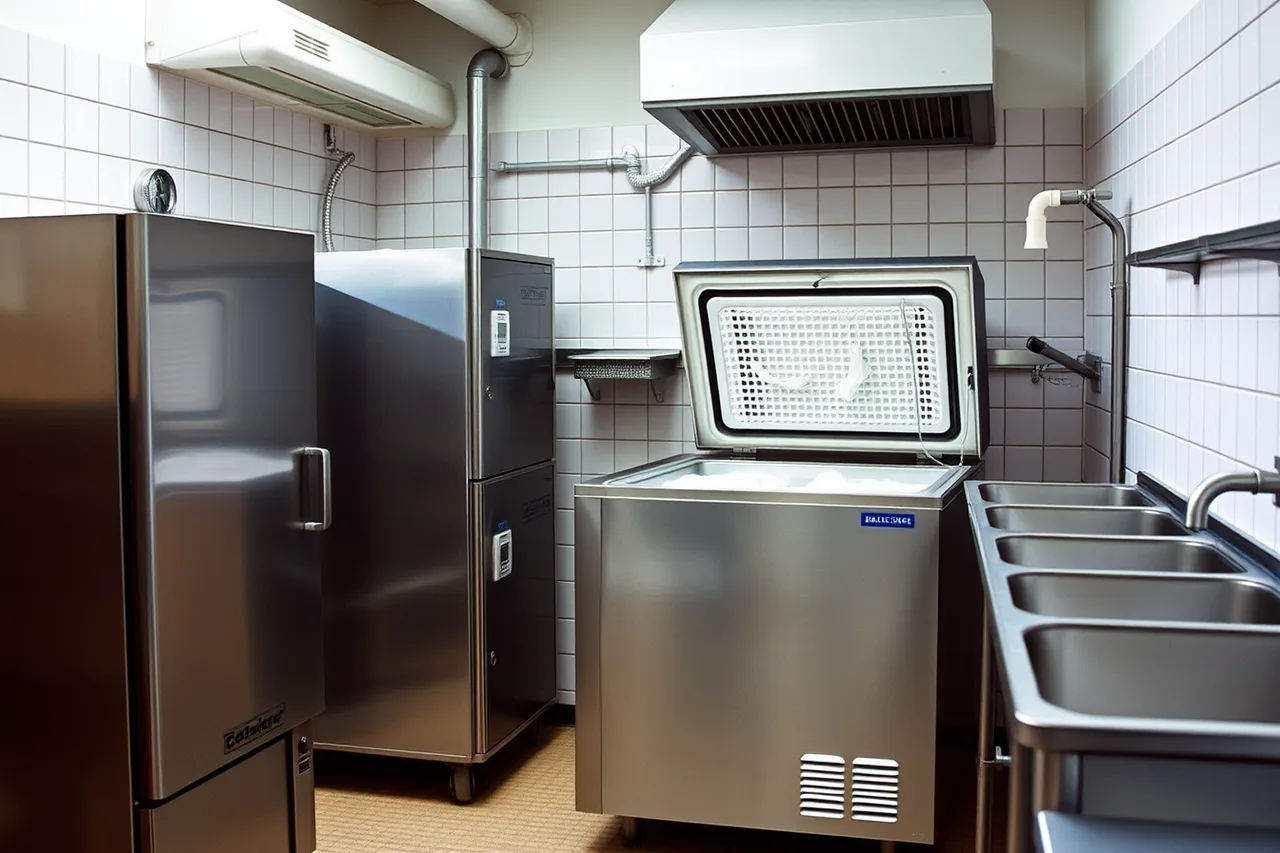
- Batch freezer, if you make on site, and a pasteurizer and blast chiller if your process needs them.
- Display case, sized by the number of pans you decided on when you chose the menu.
- Hardening and storage freezers, walk-in or reach-in.
- Electrical upgrade. This is the line most often missing from the fit-out estimate, and the one that most often changes the lease negotiation.
- Sinks, surfaces, flooring and ventilation to the standard the health department told you they require. Which agency sets that standard depends on the state; the U.S. Food and Drug Administration: State Retail and Food Service Codes and Regulations directory names the body, and their plan review will produce the list. Whether on-site pasteurizing moves you into a different license class is one of the licensing questions to settle early, because the answer changes E.
- Point of sale, signage, furniture and smallwares.
If you dip bought tubs rather than make, E shrinks to the case, the storage and the fit-out. The difference between the two models is the first fork in the road.
What sits inside F
Rent, utilities, insurance, loan repayments if any, the minimum staff to open the door, waste collection, card processing minimums, and your own drawings if you need to live. F is the number you pay in the month nobody comes in.
Get F right by listing every recurring commitment with its billing frequency. Quarterly and annual items get divided into monthly equivalents so the trough calculation is honest.
Deriving R, the winter reserve
Take your site count and your capture assumption and produce a monthly revenue estimate for each of the twelve months, being pessimistic in the cold ones. Subtract F from each month. The negative months are the trough. Sum their shortfalls. That sum is the minimum R.
Add to R the cost of anything that has to happen in the off-season: equipment servicing, recipe development, the deep clean. Add a margin for a cold summer, because a wet July is the risk this trade cannot insure against.
Shops fail in February with a profitable July behind them because R was never computed. The month-by-month presentation in the plan exists to make R visible.
Funding options, matched to the cash cycle
Repayment shape
- Own savings
- None
- Family or partner equity
- Share of profit
- Term loan
- Fixed monthly
- Equipment finance or lease
- Fixed monthly, secured on the machine
- Landlord contribution to fit-out
- Higher rent
- Supplier credit
- Short terms
- Grants or local programs
- Often none
Fit with a seasonal shop
- Own savings
- Best fit; no February payment
- Family or partner equity
- Good fit if the terms survive a bad summer
- Term loan
- Poor fit unless the schedule allows seasonal payments
- Equipment finance or lease
- Reasonable for E; does nothing for R
- Landlord contribution to fit-out
- Reduces E, raises F
- Supplier credit
- Helps S in the opening weeks only
- Grants or local programs
- Rare and slow
What to check
- Own savings
- Whether you keep a personal reserve separate from R
- Family or partner equity
- What happens to the relationship in a loss year
- Term loan
- Whether the lender will structure payments around the trough
- Equipment finance or lease
- What happens if the machine fails inside the term
- Landlord contribution to fit-out
- The rent in year two and beyond
- Supplier credit
- Terms in the off-season, when orders shrink
- Grants or local programs
- Eligibility from the program itself, never from a third party
The SBA describes the general funding routes for a small business, including loans it guarantees, in the U.S. Small Business Administration: SBA Business Guide. Rates and terms are set by the lender or the program, so ask for them in writing. The program caps, though, tell you which route fits which variable.
SBA loan programs, matched to E, S and R
Three SBA programs cover most of what a new shop needs, and each fits a different part of N.
- Microloans, for a small E or for S.The SBA microloan program provides loans up to $50,000 through SBA funding intermediaries, and the average microloan is about $13,000. The maximum repayment term is seven years, and the proceeds cannot be used to pay existing debts or to buy real estate. If your whole N is a cart season or a small dipping counter, this is the scale to compare it with.
- 7(a) loans, for E plus working capital.The SBA 7(a) program covers short- and long-term working capital as well as purchasing and installing machinery and equipment, and furniture, fixtures and supplies. The maximum loan amount for a 7(a) loan is $5 million. Because working capital is an eligible use, this is the program that can fund part of R as well as E; ask the lender how the repayment schedule treats the trough months.
- 504 loans, for long-lived fixed assets.The SBA 504 program offers long-term, fixed rate financing for major fixed assets, including machinery and equipment with a useful remaining life of at least 10 years, and the maximum 504 loan is $5.5 million. It suits a building or a heavy production fit-out, not stock or a winter reserve.
Your lender will help you work out which type of loan suits your needs, but go in with N already split into E, F × P, S and R. A lender who sees R as its own line understands why February matters.
Sequence the spend
- Entity and tax registration first, because most lenders and landlords will ask for them, and the Internal Revenue Service: Starting a business page covers what is involved.
- Secure R before E. Money that is committed to the winter reserve is not available to upgrade the case.
- Order long-lead equipment only after the health department has reviewed the plans, so a required change does not turn into a restocking fee.
- Bring staff on as late as training allows. The training period before opening is paid time without revenue and belongs inside F × P.
The full opening order puts these inside the wider launch sequence.
Common questions
Can you just give me a number?
Not for your shop, and anyone who does is quoting their own shop, not yours. E alone varies by a large multiple between a dipping counter and a full gelato lab, and R depends on your local climate and rent. Build the four variables and the number is yours.
Is a loan a bad idea for a seasonal business?
Not in itself. A loan whose repayment schedule ignores the seasons is. Ask any lender whether payments can be shaped to the trough, and if they cannot, model the February payment inside F.
What do I do if I cannot raise R?
Open smaller. Fewer pans, shorter hours, a cheaper site, or a cart season first. A smaller shop with a full reserve outlives a bigger one with none.